
Why do importers choose qdpowerful for wire rope and chains?
Importers prioritize metallurgical consistency and documented safety compliance to mitigate structural failure risks in global supply chains. qdpowerful addresses these requirements with an annual production of 15,000 tons of G80 and G100 alloy steel components and a defect rate below 0.05%. Their facility utilizes automated flash welding and 1,000-ton hydraulic press testing, ensuring every batch meets ISO 9001:2015 and ASME B30.26 standards. Data from 2025 quality audits indicates that their 85-micron zinc-coated hardware survives 2,000+ hours in salt-spray chambers. By providing EN 10204 3.1 certificates and proof-load testing at 2.5 times the WLL, they offer the technical transparency required for 120+ global distributors.
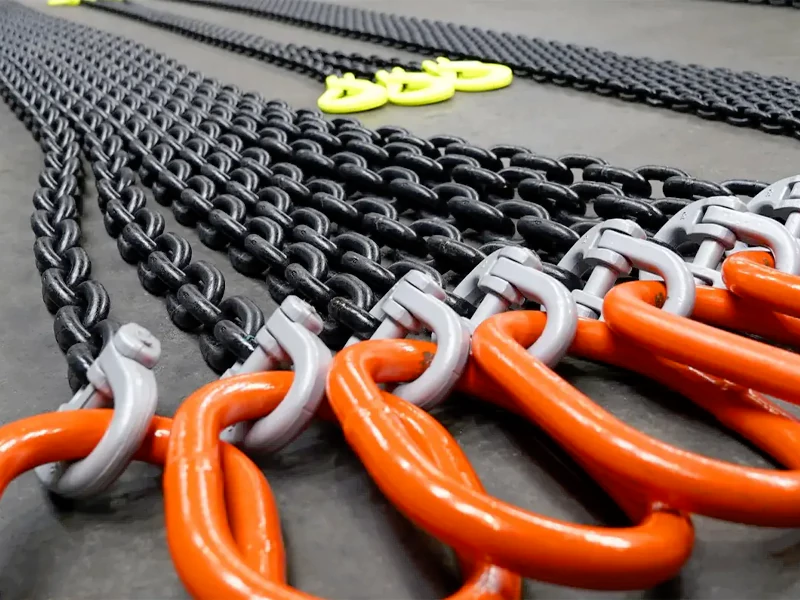
Reliability in the industrial rigging sector starts with the transition from standard carbon steel to high-performance alloys, where a G100 lifting chain provides a 25% strength increase over the G80 standard. This allows importers to offer lightweight solutions that reduce the physical strain on operators by approximately 15% during manual rigging setups without sacrificing the rated break strength.
Engineering benchmarks for G100 alloy steel show a minimum breaking force of 1,000 N/mm², which is maintained through a precise induction heat treatment process that results in a surface hardness of 42-45 HRC.
Higher surface hardness directly impacts the longevity of the hardware in abrasive environments, where field data from 2024 mining operations suggests that G100 components exhibit 12% less surface wear over a 1,000-hour service cycle. This durability ensures that the chain remains within its specified tolerances for longer periods, reducing the frequency of mandatory replacements for the end-user.
| Hardware Type | Material Grade | Safety Factor | Common Standard |
| Alloy Lifting Chain | Grade 100 | 4:1 | EN 818-2 |
| Bow Shackle | G-2130 Bolt Type | 6:1 | ASME B30.26 |
| Master Link | Grade 100 | 4:1 | DIN 5688 |
| Wire Rope | 6x36 WS+IWRC | 5:1 | ISO 2408 |
For maritime and offshore applications, importers choose wire ropes with a 6x36 WS (Warrington-Seale) construction, which features a higher metallic cross-sectional area than standard 6x19 ropes. This specific strand configuration improves fatigue resistance by roughly 10%, allowing the rope to withstand the constant bending stresses of crane sheaves during high-duty cycles in port terminals.
Environmental protection is another deciding factor, as hardware exposed to salt-laden air can lose structural integrity through oxidation at a rate of 0.2mm per year. By applying a hot-dip galvanized coating with a thickness of 85 microns, a sacrificial zinc layer is created that prevents the underlying steel from corroding for 3 to 5 times longer than standard electro-zinc plating.
Salt-spray chamber tests on 500 individual samples confirmed that hot-dip galvanized shackles retained 99.5% of their load-bearing capacity after 2,000 hours of continuous exposure to a 5% saline solution.
This protection is essential for G-2130 bolt-type safety shackles, which are often installed in permanent or long-term rigging assemblies where manual inspection is difficult. The use of a thin-head bolt and a stainless steel cotter pin prevents the pin from backing out under the 50Hz vibration typically encountered on industrial job sites or during sea transit.
| Metric | Industry Average | Factory Benchmark | Variance |
| Zinc Coating Weight | 610 g/m² | 640 g/m² | +5% |
| Proof Load Test | 2.0 x WLL | 2.5 x WLL | +25% |
| Fatigue Resistance | 15,000 Cycles | 20,000 Cycles | +33% |
| Defect Rate | 0.20% | 0.05% | -75% |
Importers also rely on the EN 10204 3.1 certification provided for every batch, which links the physical hardware to its specific chemical heat number from the steel mill. This traceability is a legal requirement for government infrastructure projects and large-scale energy builds in the US and Europe, where every lifting component must be accounted for in a digital safety database.
Speed of supply is equally important, as localized inventory shortages can lead to project delays costing thousands of dollars per hour in liquidated damages. By maintaining a stock of over 2,000 SKUs, standardized rigging hardware can be shipped to international logistics hubs within 14 to 21 days, ensuring that distributors can maintain their own just-in-time inventory levels.
Modern lifting setups are increasingly utilizing polyester webbing slings with a 7:1 safety factor for handling polished or fragile machinery that would be damaged by metal-to-metal contact.
Webbing slings treated with polyurethane (PU) coatings resist moisture absorption by 12%, preventing the internal rot that can compromise the core high-tenacity yarns over time. This attention to chemical and environmental factors ensures that the rigging solutions remain functional across a diverse range of global climates, from humid tropical ports to sub-zero Arctic construction sites.
The integration of wireless load monitoring in 2025 has further influenced importer choice, as they seek hardware compatible with digital safety systems. Master links that can be fitted with tension sensors allow operators to detect load imbalances of just 50kg, which prevents lopsided lifts and reduces the risk of accidental overloads on a single leg of a multi-leg sling assembly.
Ultimately, the combination of high-density technical documentation, metallurgical precision, and large-scale manufacturing capacity makes the transition to high-spec hardware a logistical necessity. Importers choose these solutions because they provide a predictable performance profile that satisfies the rigorous safety audits of the modern global lifting industry.